
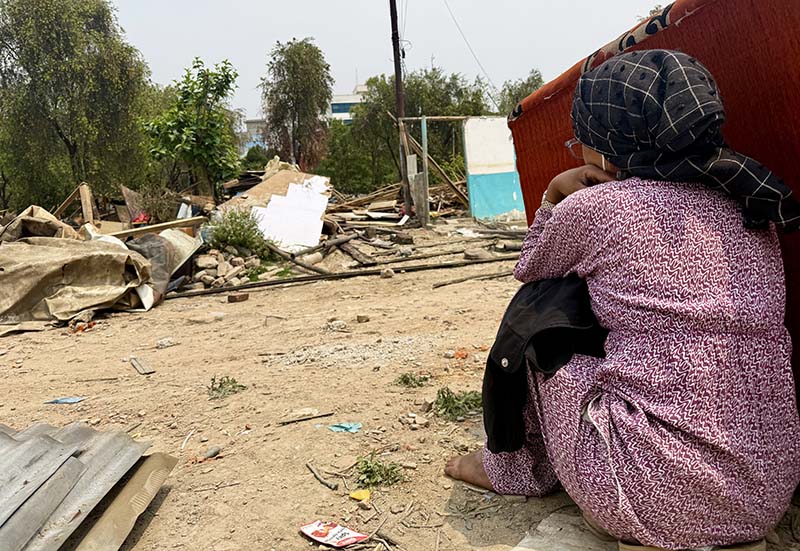
After Maitimaya Tamang’s home on the banks of the Bagmati, a shack built of bamboo, plastic and tin through years of labor as a daily wage worker, cleaner and corn seller, was demolished by the government with just one day’s notice, she is left terrified of the state and uncertain of her future.
The 34-year-old Maitimaya Tamang was in a state of shock, her eyes brimming with tears. Yet, there was no room to simply sit and cry. At times she would mumble to herself, and at others, she would stare blankly at the scene of the bulldozer leveling her home, as if it were a scene from a movie rather than reality.
Maitimaya’s life has seen many unimaginable sorrows, but this time, the state itself turned against her. Her home was among the 149 houses in the Thapathali settlement on the Bagmati riverbank demolished on April 25, 2026, as part of the Balendra Shah-led government’s campaign to clear squatter settlements.
With tin walls supported by bamboo slats, a tin roof and plastic sheets covering leaks, the structure hardly looked like a house at first glance. However, for Maitimaya, this shelter that had protected her for 11 years was no less than a palace. It was the sanctuary where she hid her sorrows and the playground for her two young daughters’ childhood antics.
She had done everything she could to make that house feel like a home.
“When rats made large holes in the dirt floor, I worked manual labor jobs to save enough for cement to floor it,” she said, taking a final look at her home as the bulldozer tore into it on the morning of April 25. “Bulldozers usually come to build others’ houses. They came to destroy mine.”
The home she spent a decade building was reduced to rubble in minutes by the government’s bulldozer. A long sigh escaped her as she fell silent for a moment, perhaps lost in her memories.
The government’s campaign to remove encroached structures, which began on the banks of the Bagmati on April 25, has since spread rapidly across the Valley. Beyond the Bagmati, the government has already demolished numerous houses along the Manhara, Dhobi Khola and Bishnumati rivers, targeting not only squatter settlements but also structures built on encroached public land or those failing to meet official standards.
According to Uddhav Nepal, Deputy Project Director of the High-Powered Committee for Integrated Development of the Bagmati Civilization under the Ministry of Urban Development, there are 3,496 squatters living along the riverbanks of the Valley alone. Most of their homes have been demolished during this period.
One of those houses belonged to Maitimaya. She had arrived in this unfamiliar city after being hounded by one hardship after another, not in search of a dream, but in search of life itself, clinging to any means of survival. This journey began in 2008, the year she got married.
Originally from Ri village in Dhading, she married Tek Bahadur Pahari of Bhumlu Rural Municipality in Kavre. It was only after moving to Kavre following the wedding that she realized her new family’s livelihood depended on shedding sweat on other people’s land.
Despite working all year round, they faced food shortages for four months of the year. Amidst this struggle, she gave birth to her daughter, Roshani, a year later. However, the scarcity of food and clothing only worsened. The single kattha (0.0837 acre) of land her mother-in-law had received from her maternal home was not enough to sustain the family. Her father-in-law and husband had survived for years by tilling others’ fields. When her father-in-law was no longer physically able to work, the entire burden shifted to Tek Bahadur’s shoulders.
The sweat shed in the village couldn't fill five stomachs. To win the battle against hunger, Tek Bahadur made a difficult decision in 2010, to leave the village and move to the city.
“Even after he moved to the city, I stayed in the village to plant corn and millet,” Maitimaya recalls. “But there was no harvest. We had to buy everything we ate.”
Life in the city was not easy for Tek Bahadur either. Initially, he worked as a daily-wage porter in New Road. When night fell, he didn’t always have a place to take shelter. He stayed with relatives and friends for a few days but that was not a sustainable solution. His earnings as a porter were not enough to afford a rented room.
In the meantime, he heard from friends about vacant land in Thapathali where squatters lived. In 2012, pursuing that possibility, he reached the same Thapathali settlement that the bulldozers have now leveled to the ground. Maitimaya recalls Tek Bahadur telling her how he spent his nights on the banks of the Bagmati under a tarp back then.
The 2015 earthquake destroyed their home in Kavre. After the house they considered safe collapsed, they began living in the fields. Insecurity and uncertainty were growing. The money Tek Bahadur sent from Kathmandu was never enough. Their daughter would fall ill, the elderly parents-in-law needed medical treatment, and expenses would suddenly spike. At those times, Maitimaya had only one option: debt.
The earthquake brought another tremor to Maitimaya’s life, which was already weighed down by debt. Unable to hold on in the village, she moved to the city in May/June 2015 with her four-year-old daughter in search of work. The tarp Tek Bahadur had pitched in the Thapathali squatter settlement became their whole world.
According to Maitimaya, Tek Bahadur himself was not healthy. He suffered from epilepsy. Sometimes he would fall semi-conscious while working and other times he had to be helped up from where he slept. The illness gradually restricted his ability to work, and with it, the family’s income. “That is why I looked for work the very day I arrived in Kathmandu,” Maitimaya says. “I was forced to leave my daughter with neighbors in the settlement so I could go to work.”
In reality, that compulsion was not just born of scarcity. It was also the fear of whether or not she could survive in this city.
Her first job was carrying bricks.
The wage was 500 rupees a day.
The work was heavy but there was no alternative.
She spent a year doing that – carrying bricks all day and returning to the tarp in the evening. In that cycle, she slowly began putting her world together, adding household and kitchen essentials one by one. In 2016, she continued this labor until she was five months pregnant with her younger daughter.
Her younger daughter, Ayusha, was born in 2017. There were no signs of life becoming easier. Her husband’s health was deteriorating further and Tek Bahadur had already stopped working.
Consequently, she had to return to work just a month and a half after giving birth. This time, she left manual labor behind and started cooking, cleaning and doing laundry at a house in Thapathali. Gradually, she began working in three different houses a day. Leaving her two daughters at home, her daily routine became working in others’ homes from morning until evening.
For a while, it felt as though her life had found a rhythm. However, her husband’s illness necessitated more frequent hospital visits. Time, money and energy were all consumed by his care.
In 2020, after being seized by an epileptic fit, Tek Bahadur fell unconscious and never woke up. After a week of treatment at Civil Hospital, her husband passed away, and Maitimaya’s world collapsed once again.
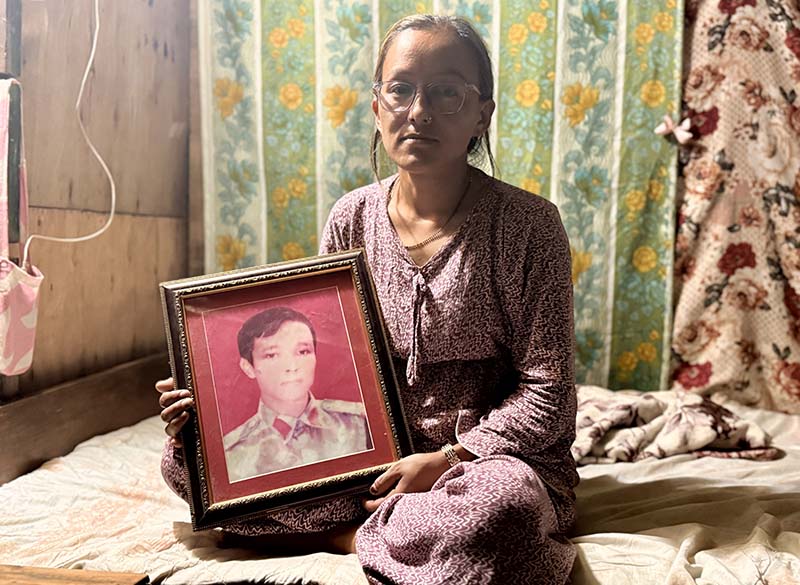
The responsibility of raising two young daughters rests on her shoulders. Carrying the weight of an uncertain future, she had to find a way to survive. For their livelihood, she began roasting corn by the roadside near Babarmahal. That job was not just a means to fill stomachs. It slowly became a beacon of hope for her. By roasting and selling up to 60 ears of corn a day, she earned up to 800 rupees. With those earnings, she managed the household and, bit by bit, put up a tin roof over her shelter on the Bagmati riverbank.
Her income was not enough to cover the education of both daughters. She entrusted her eldest daughter, Roshani, to the care of Change Action Nepal. To this day, that organization has been sponsoring her daughter’s education and living expenses. According to Indira Ghale, Executive Director of Change Action Nepal, 24 children from the settlement have received scholarships from the organization.
Maitimaya kept her younger daughter with her while trying to manage her schooling. Just as it began to feel like things were finally falling into place, her life took another turn. “Roasting corn on the street was going well but the Metropolitan City started a crackdown and wouldn’t let us stay,” Maitimaya says. “I was thinking of slowly saving up to buy a cart but the Metropolitan City uprooted us entirely.”
City police would come and confiscate her roasting pan, her firewood, sacks of corn, and sometimes even take her into custody. After being hauled away four times like this, she grew weary. She had to give up the profession that had given her hope to live again and allowed her to dream small dreams. Once more, her life was caught in that same whirlwind where nothing was stable, leaving her unemployed for months.
After some time, she began carrying bricks again at a construction site near the settlement. Although the contractor suggested she avoid such heavy labor due to her frail physique, she had no other option. By doing this work to make ends meet, she had decorated her own little world within that squatter settlement. Recently, Maitimaya has been working as a cleaner in an office located in Thapathali (the name of which has been withheld at her request).
Having previously slept on the floor, she eventually managed to buy a bed. She created a small kitchen garden in front of her house and built a coop to raise chickens in that tiny yard. To others, it was just a squatter settlement. But for her, the home she built with her own hard work was a matter of self-respect.
She knew that her monthly income of 10,000 rupees would not be enough to rent a room or educate her daughters. Therefore, she had one dream: to live in this settlement until her daughters found jobs. “But they didn't let even that dream of mine come true,” she says.
When the bulldozer moved in on the house
Until the morning of April 24, just a day before the bulldozers arrived, Maitimaya had never imagined she would actually have to leave the banks of the Bagmati.
She believed the government’s warnings would remain just that, as they always had in the past. But this time was different. As the residents of the settlement began vacating their homes in fear, that same dread took hold of her. She, too, was forced to start looking for a new place to stay. On the evening of April 24, when the Kathmandu Metropolitan City issued a final order over loudspeakers to vacate the area, she set out like everyone else to find a room.
However, the city is not always welcoming to everyone. She couldn’t find a room anywhere nearby and began to panic. The staff at the office where she works as a cleaner noticed her distress. They have since provided her with a small room on the ground floor of the office to stay in temporarily.
Because the room is so small, there isn’t enough space for both mother and daughter. As a result, she has sent her younger daughter to stay for a while at the same organization where her eldest daughter is living.
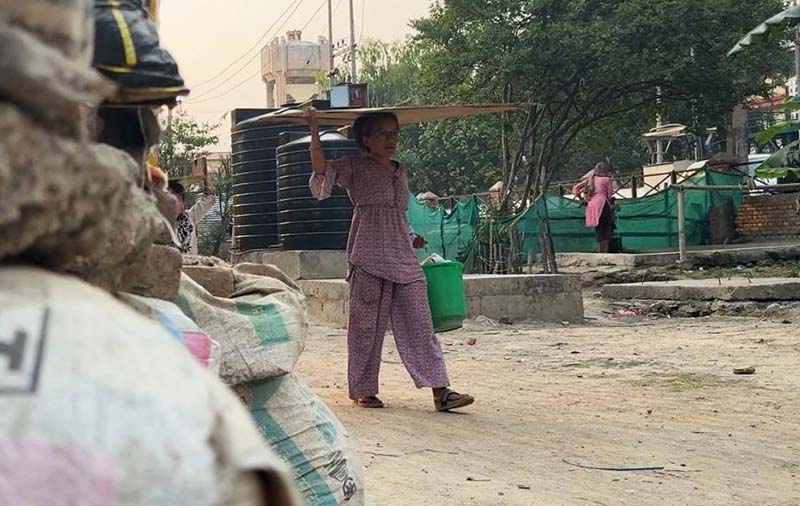
Moving a decade’s worth of belongings on a single day’s notice was no easy feat. Every item, the utensils, the bed and the clothes, carried the weight of her blood, sweat, and time. “I never thought they would uproot the settlement in a single day,” she says. “If I have to rent a room now, will all my earnings just vanish into rent?"
Amidst the uncertainty, Maitimaya spent the entire night hauling her belongings to that small room. Despite the exhaustion of repeated trips back and forth within Thapathali, sleep eluded her. She was driven by a single fear. If she was late, the bulldozer would crush her things.
That fear proved to be well-founded. By 6:00 am the next morning, Saturday, April 25, the bulldozers had already arrived at the settlement. She was still pulling things out, but in the rush, she couldn’t manage to save everything. A bed, a table and a sofa had to be left behind.
She consoles herself with the fact that there was no place left to put them anyway. She didn’t want to clutter the office where she worked and there was no one to help her carry the remaining items.
Her eldest daughter, Roshani, had arrived at the settlement at 6:00 am to help her mother but she says the police stopped her at the gate and refused to let her in. “Once the bulldozers started, they didn’t let anyone through,” Maitimaya says. “They blocked my daughter at the gate. Even when I went to get her, they wouldn’t let her inside. It was such a day of terror.”
Roshani, saddened that she didn’t get to see her home one last time before it was demolished, feels that the government must provide them with an alternative arrangement.
Recalling how Balendra Shah had attempted to remove the squatter settlements back when he was the Mayor of Kathmandu Metropolitan City, Maitimaya says, “We left the settlement out of sheer fear. We figured if he used bulldozers as a Mayor, what would he leave standing now that he is the Prime Minister?"
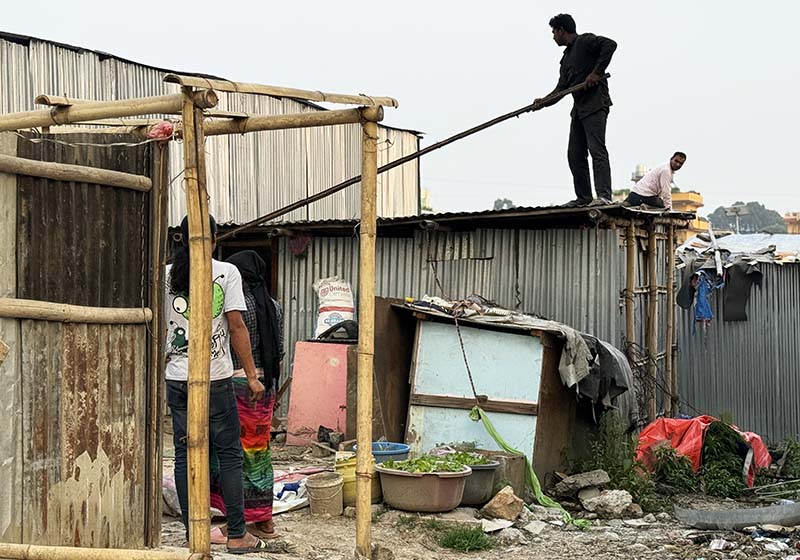
Removing squatters from their dwellings without their consent or willingness and placing them in unmanaged holding centers is a violation of human rights, according to social researcher Ramchandra Shrestha. He states, “Instead of moving swiftly to execute the management framework for squatters as outlined by the Constitution and relevant Acts, uprooting these settlements is an act of state violence.”
The Constitution of Nepal ensures the Right to Housing (Article 37) and the Rights of Dalits (Article 40) as fundamental rights. Article 40, Clause 5, explicitly stipulates that ‘the State shall provide land once to landless Dalits in accordance with the law’. Similarly, Clause 6 states that ‘the State shall make arrangements for settlement for houseless Dalits in accordance with the law.’
Furthermore, Article 42 ensures the right to housing for citizens from economically marginalized and endangered communities. Under the Policies of the State in Article 51 (j), sub-clause (6) mentions ‘identifying freed kamaiya, kamalari, haruwa-charuwa, haliya, the landless, and squatters, and rehabilitating them by providing housing plots and either arable land or employment for their livelihood’.
To implement these constitutional provisions, the eighth amendment to the Land Act (1964) provided for the formation of the National Land Commission. To date, 1,129,517 individuals have submitted applications to the Commission claiming to be squatters in search of land and ownership certificates.
Among these applicants, 872,181 are identified as occupants of unmanaged settlements, 88,895 as landless Dalits, and 168,441 as landless squatters. According to the Commission, the verification of these applications is still pending.
In contradiction to the Act and the Constitution, these landless squatters have been removed from their settlements without proper data collection or verification. The government has stated it will verify the displaced individuals while they are kept in holding centers.
Prime Minister Balendra Shah wrote a Facebook status on May 4, stating that the government has begun working toward a systematic, transparent and sustainable solution by identifying the true situation of landless citizens. “Provisions for safe and systematic relocation will be made for citizens living in unsafe locations where their lives are at risk,” he wrote.
“Regarding other landless citizens, the Government of Nepal will make necessary decisions based on the recommendations of the relevant commission and the collected data.”
Social researcher Ramchandra Shrestha, however, questions the process initiated by the government. He objects to the fact that squatters were uprooted from their dwellings and left in a state of abandonment. He argues that even if the commission’s work was slow, the government could have expedited the process by appointing preferred members to a new committee. Instead, he believes the government chose the wrong path by deploying bulldozers first.
Registration Number 105
The government has begun registering the names of displaced individuals, stating that they will investigate the matter for the management of squatters. However, she has no hope or trust in the government. “How can I trust a government that clears a settlement with just one day’s notice?" she asks.
Despite her lack of hope and trust, she went to Dasharath Stadium and registered her name on the list of displaced persons, fearing she might be left out later. Her registration number is 105. According to Prakirn Tuladhar, spokesperson for the Kathmandu Valley Development Authority, more than 5,000 individuals from over 1,200 families have registered so far. He states that proper management will be arranged within a few months after investigating those who have registered.
Maitimaya wants the government to investigate her background thoroughly. She says, “Our family didn’t own land even back in my father-in-law’s generation. If they find any, they can take it. But if they don’t find any, will they actually give us some?”
She anticipates that even if the government provides a place to stay, they will be looked down upon. Her experience tells her that those without land titles have a weaker voice. They do not receive respect and are treated with contempt as the lower class.
“When you don’t have a piece of land in a place where you can make a living, people don’t even trust you for a loan,” she says. “Land is land. If the government can, let them give us a piece of land in a place where we can work and sustain ourselves.”
In collaboration with Report for the World. Please adhere to our republishing policy if you'd like to republish this story. You can find the guidelines here.
Comments